

Note: Please check your Spam or Junk folder, in case you didn't receive the email with verification code.

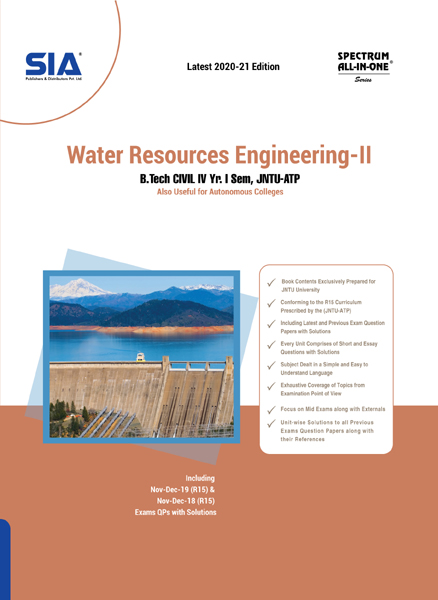
Water Resources Engineering-II, B.Tech IV-Year I-Sem (CE) R15, JNTU-Anantapur, Latest 2020-21 Edition
SYLLABUS
UNIT-I
CANAL REGULATION WORKS: Canal falls: Necessity and location of falls: Types of falls; Classification of falls; Cistern design; Roughening devices; Design of Sarada type fall. Canal Regulators; Off-take alignment; Head regulators and Crossregulators; Design of cross-regulator and distributary head regulator. CROSS DRAINAGE WORKS: Introduction; Types of cross drainage works; Selection of suitable type of cross drainage work; Classification of aqueducts and siphon aqueducts.
UNIT-II
STREAM GAUGING: Necessity; Selection of gauging sites; Methods of discharge measurement: Area-Velocity method; SlopeArea method; Tracer method, Electromagnetic induction method, Ultrasonic method; Measurement of depth – Sounding rod, Echo-sounder; Measurement of velocity; Floats – Surface floats, Sub-surface float or double float, Velocity rod; Pitot tube; Current meter-rating of current meter, Measurement of velocity; Chemical method; Measurement of stage-staff gauge, Wire gauge, Water stage recorder, Bubble gauge recorder; Stage-discharge curve. RIVER ENGINEERING: Classification of rivers; Meandering; Causes of meandering; Basic factors controlling process of meandering; Aggrading type of river; Degrading type of river; River training: Objectives, Classification of river training works; Types of river training works; Guide banks, Marginal embankments, Groynes or spur, levees, bank protection, Pitched islands.
UNIT-III
RESERVOIR PLANNING: Introduction; Investigations for reservoir planning; Selection of site for a reservoir; Zones of storage in a reservoir; Storage capacity and yield; Mass inflow curve and demand curve; Calculation of reservoir capacity for a specified yield from the mass inflow curve; Determination of safe yield from a reservoir of a given capacity; Sediment flow in streams: Reservoir sedimentation; Life of reservoir; Reservoir sediment control; Flood routing; Methods of flood routing-Graphical method (Inflow – storage discharge curves method). DAMS:GENERAL: Introduction; Classification according to use; Classification according to material – Gravity dams, Arch dams, Buttress dams, Steel dams, Timber dams, Earth dams and rock fill dams-advantages and disadvantages; Physical factors governing selection of type of dam; Selection of site for a dam.
UNIT-IV
GRAVITY DAMS: Introduction; Forces acting on a gravity dam; Combination of loading for design; Modes of failure: Stability requirements; Principal and shear stresses, Stability analysis; Elementary profile of a gravity dam; Practical profile of a gravity dam; Limiting height of a gravity dam – High and low gravity dams; Design of gravity dams – Single step method; Galleries; Stability analysis of non-overflow section of gravity dam. EARTH DAMS: Introduction; Types of earth dams; Causes of failure of earth dams; Criteria for safe design of earth dams; Section of an earth dam; Design to suit available materials; Seepage control measures; Slope protection. Seepage through earth dam – Graphical method.
UNIT-V
SPILLWAYS: Introduction; Types of spillways; Profile of ogee spillway; Energy dissipation below spillways for relative positions of jump height curve and tail water curve, Stilling basins; Indian standards on criteria for design of hydraulic jump type stilling basins with horizontal aprons; Spillway crest gates – Types and description only. WATER POWER ENGINEERING: Development of hydro power in India; Classification of hydel plants; Runoff river plants, Storage plants and pumped storage plants; Low, Medium and High head schemes; Investigation and planning; Components of hydel schemes – Fore bay, intake structure, Surge tanks, Penstocks, Power house, Turbines-selection of suitable type of turbine, Scroll casing draft tube and tail race; Assessment of available power; Definition of gross head, Operating head, Effective head; Flow duration curve; Power duration curve; Load duration curve; Load curve; Primary power and secondary power; Installed capacity, Dependable capacity; Firm power, Secondary power; Power factor; Load factor, Capacity factor, Utilization factor and Diversity factor.
 No Preview is available for this book
 Get 100 instant uPoints on the purchase of Rs.100 or above for each order.
CategoriesEngineering

Format EPUB

TypeeBook


 0
0
 Facebook
 Twitter
 Email
Email