

Note: Please check your Spam or Junk folder, in case you didn't receive the email with verification code.

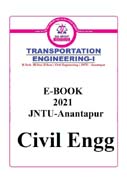
Transportation Engineering-I (JNTU-A) B.Tech III-II (CE) R15
SYLLABUS
UNIT-I
HIGHWAY DEVELOPMENT AND PLANNING: Highway development in India – Necessity for highway planning – Different road development plans – Classification of roads – Road network patterns – Highway alignment – Factors affecting alignment – Engineering surveys – Drawings and reports.
UNIT-II
HIGHWAY GEOMETRIC DESIGN: Importance of geometric design – Design controls and criteria – Highway cross section elements – Sight distance elements – Stopping sight distance, Overtaking sight distance and intermediate sight distance – Design of horizontal alignment – Design of super elevation and extra widening – Design of transition curves – Design of vertical alignment – Gradients – Vertical curves.
UNIT-III
TRAFFIC ENGINEERING: Basic parameters of traffic – Volume, Speed and density – Definitions and their inter relation – Highway capacity and level of service concept – Factors affecting capacity and level of service – Traffic volume studies – Data collection and presentation – Speed studies – Data collection and presentation – Parking studies and parking characteristics – Road accidents – Causes and preventive measures – Accident data recording – Condition diagram and collision diagrams. TRAFFIC REGULATION AND MANAGEMENT: Road traffic signs – Types and specifications – Road markings – Need for road markings – Types of road markings – Specifications – Design of traffic signals – Webster method – Saturation flow – Phasing and timing diagrams – Numerical problems.
UNIT-IV
INTERSECTION DESIGN: Conflicts at intersections – Channelisation : Objectives – Traffic islands and design criteria – Types of Atgrade intersections – Types of grade separated intersections – Rotary intersection – Concept of rotary and design criteria – Advantages and disadvantages of rotary intersection.
UNIT-V
PAVEMENT DESIGN: Types of pavements – Difference between flexible and rigid pavements – Pavement components – Sub grade, Sub base, Base and wearing course – Functions of pavement components – Design factors – Flexible pavement design methods – G.I method, CBR method, (as per IRC 37-2002) – Design of rigid pavements – Critical load positions – Westergaard’s stress equations – Computing radius of relative stiffness and equivalent radius of resisting section – Stresses in rigid pavements – Design of expansion and contraction joints in CC pavements. Design of Dowel bars and Tie bars.
 No Preview is available for this book
 Get 100 instant uPoints on the purchase of Rs.100 or above for each order.
CategoriesEngineering

Format PDF

TypeeBook


 0
0
 Facebook
 Twitter
 Email
Email