

Note: Please check your Spam or Junk folder, in case you didn't receive the email with verification code.

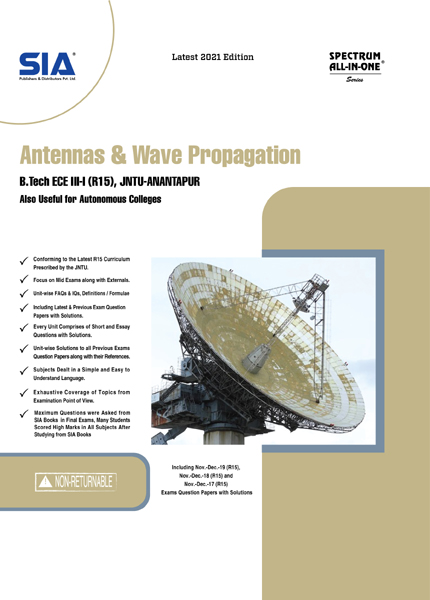
Antennas and Wave Propagation, B.Tech III-Year I-Sem (ECE) R15 JNTU-Anantapur, Latest 2021 Edition
SYLLABUS
UNIT-I
Antenna Basics & Dipole Antennas : Introduction, Basic antenna parameters – Patterns, Beam area, Radiation intensity, Beam efficiency, Directivity-Gain-Resolution, Antenna apertures, Effective height, Fields from oscillating dipole, Field zones, Shape-Impedance considerations, Polarization – Linear, Elliptical and circular polarizations. Antenna temperature, Antenna impedance, Front-to-back ratio, Antenna theorems, Radiation – Basic Maxwell’s equations, Retarded potential – Helmholtz Theorem, Radiation from small electric dipole, Quarter wave monopole and half wave dipole – Current distributions, Field components, Radiated power, Radiation resistance, Beam width, Natural current distributions, Far fields and patterns of thin linear center-fed antennas of different lengths, Illustrative problems.
UNIT-II
VHF, UHF and Microwave Antennas-I : Loop antennas-Introduction, Small loop, Comparison of far fields of small loop and short dipole, Radiation resistances and directives of small and large loops (Qualitative Treatment), Arrays with parasitic elements - Yagi-Uda Arrays, Folded dipoles and their characteristics, Helical AntennasHelical geometry, Helix modes, Practical design considerations for monofilar helical antenna in axial and normal modes, Horn antennas-Types, Fermat’s principle, Optimum horns, Design considerations of pyramidal Horns, Illustrative Problems.
UNIT-III
VHF, UHF and Microwave Antennas-II : Micro strip antennas – Introduction, Features, Advantages and limitations, Rectangular patch antennas – Geometry and parameters, Characteristics of micro strip antennas, Impact of different parameters on characteristics, Reflector antennas – Introduction, Flat sheet and corner reflectors, Parabola reflectors – Geometry, Pattern characteristics, Feed methods, Reflector types – Related features, Lens antennas – Geometry of non-metallic dielectric lenses, Zoning, Tolerances, Applications, Illustrative Problems.
UNIT-IV
Antenna Arrays : Point sources – Definition, Patterns, Arrays of 2 isotropic sources – Different cases, Principle of pattern multiplication, Uniform linear arrays – Broadside arrays, Endfire arrays, EFA with increased directivity, Derivation of their characteristics and comparison, BSA with non-uniform amplitude distributions – General considerations and binomial arrays, Illustrative problems. Antenna Measurements : Introduction, Concepts – Reciprocity, Near and far fields, Coordination system, Sources of errors, Patterns to be measured, Pattern measurement arrangement, Directivity measurement, Gain measurements (By comparison, Absolute and 3-antenna methods).
UNIT-V
Wave Propagation: Introduction, Definitions, Characterizations and general classifications, Different modes of wave propagation, Ray/Mode concepts, Ground wave propagation (Qualitative treatment) – Introduction, Plane earth reflections, Space and surface waves, Wave tilt, Curved earth reflections, Space wave propagation – Introduction, Field strength variation with distance and height, Effect of earth’s curvature, Absorption, Super refraction, M-curves and duct propagation, Scattering phenomena, Tropospheric propagation, Fading and path loss calculations, Sky wave propagation – Introduction, Structure of ionosphere, Refraction and reflection of sky waves by ionosphere, Ray path, Critical frequency, MUF, LUF, OF, Virtual height and skip distance, Relation between MUF and skip distance, Multi-HOP propagation, Energy loss in ionosphere, Summary of wave characteristics in different frequency ranges, Illustrative problems.
 No Preview is available for this book
 Get 100 instant uPoints on the purchase of Rs.100 or above for each order.
CategoriesEngineering

Format EPUB

TypeeBook


 0
0
 Facebook
 Twitter
 Email
Email