

Note: Please check your Spam or Junk folder, in case you didn't receive the email with verification code.

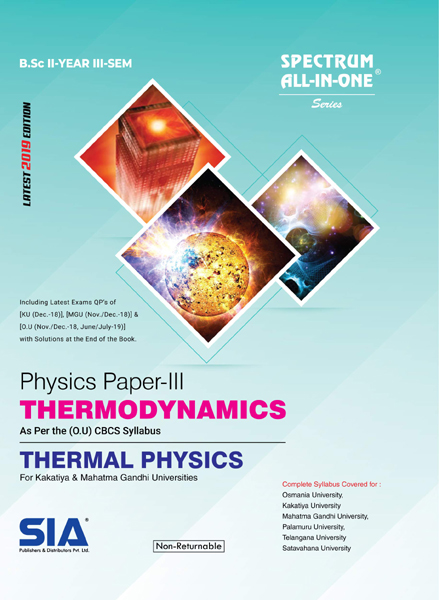
Physics Paper-III (Thermodynamics (O.U)), B.Sc II-III (O.U)
Unit - I
1. Kinetic Theory of Gases
Introduction – Deduction of Maxwell’s law of distribution of molecular speeds, Transport phenomena –
Viscosity of gases – Thermal conductivity – Diffusion of gases.
2. Thermodynamics
Basics of thermodynamics – Kelvin’s and Claussius statements – Thermodynamic scale of temperature –
Entropy, Physical significance – Change in entropy in reversible and irreversible processes – Entropy and
disorder – Entropy of universe – Temperature – Entropy (T-S) diagram – Change of entropy of a perfect gas
– Change of entropy when ice changes into steam.
Unit - II
3. Thermodynamic Potentials and Maxwell’s Equations
Thermodynamic potentials – Derivation of Maxwell’s thermodynamic relations – Clausius – Clayperon’s
equation – Derivation for ratio of specific heats – Derivation for difference of two specific heats for perfect
gas. Joule Kelvin effect – Expression for Joule Kelvin coefficient for perfect and Vanderwaal’s gas.
4. Low Temperature Physics
Joule kelvin effect – Liquefaction of gas using porous plug experiment. Joule expansion – Distinction
between adiabatic and Joule Thomson expansion – Expression for Joule Thomson cooling – Liquefaction
of helium, Kapitza’s method – Adiabatic demagnetization – Production of low temperatures – Principle of
refrigeration, vapour compression type.
Unit - III
5. Quantum Theory of Radiation
Black body-Ferry’s black body – Distribution of energy in the spectrum of black body – Wein’s displacement
law, Wein’s law, Rayleigh-Jean’s law – Quantum theory of radiation – Planck’s law – Deduction of Wein’s
distribution law, Rayleigh – Jeans law, Stejan’s law from Planck’s law.
Measurement of radiation using pyrometers – Disappearing filament optical pyrometer – Experimental Determination
– Angstrom pyroheliometer – Determination of solar constant, Effective temperature of sun.
Unit - IV
6. Statistical Mechanics
Introduction, postulates of statistical mechanics. Phase space, concept of ensembles and some known
ensembles, classical and quantum statistics and their differences, concept of probability, Maxwell-
Boltzmann’s distribution law – Molecular energies in an ideal gas-Maxwell-Boltzmann’s velocity distribution
law, Bose-Einstein Distribution law, Fermi-Dirac Distribution law, comparison of three distribution laws,
Application of B-E distribution to Photons-planks radiation formula, Application of Fermi-Dirac statistics
to white dwarfs and Neutron stars.
 No Preview is available for this book
 Get 100 instant uPoints on the purchase of Rs.100 or above for each order.
CategoriesArts and Science

Format EPUB

TypeeBook


 0
0
 Facebook
 Twitter
 Email
Email